
Imagine that you are sitting on your couch watching television, and you feel absolutely fine.
Your breathing is normal, your chest feels clear, and you have zero complaints about your health.
But then, the power goes out, and you have to walk up three flights of stairs to check the generator.
By the time you reach the top, you are gasping for air. Your chest feels incredibly tight, as if someone has placed a heavy block on it.
You have to sit down for several minutes just to catch your breath.
This scenario happens every single day, and it highlights one of the most frightening realities about human health.
Your heart is a master at hiding its struggles when you are just sitting around.
If you only evaluate your heart health based on how you feel while resting, you are playing a very dangerous game with your life.
To truly see what is going on inside those arteries, doctors need to see how your heart behaves when it is forced to work hard.
That is exactly why the TMT stress test procedure exists, and why it is one of the most important screenings you can ever book at our hospital.
The Hard Truth About Heart Health in Nigeria
Many people confuse 2D Echo test with TMT Stress test, but here is an honest truth.
Before we talk about treadmills and wires, we need to have an honest conversation about what is happening in our communities.
Many of us grew up believing that heart attacks only happen to very old people or people who are severely overweight.
We brush off chest pain as indigestion. We ignore feeling winded because we just assume we are getting older.
But the medical data tells a completely different, much more urgent story.
When researchers recently looked at 16 years of admission records at the Lagos University Teaching Hospital (LUTH), they uncovered a frightening trend: cardiovascular diseases accounted for 20.8% of all medical admissions.
Heart issues are not rare occurrences; they are flooding our hospital beds.
Even worse, the data showed a continuous, year-over-year increase in these heart-related emergencies, with stroke and heart failure making up the vast majority of the cases.
Much of this tragedy is driven by silent killers like high blood pressure.
Recent medical data shows that 34.2% of adults in Nigeria (roughly one in three people) are living with hypertension.
Yet a shocking 29.0% of those individuals are the only ones actually aware that they have it.
The vast majority have absolutely no idea their blood pressure is dangerously high until they end up in the emergency room.
You cannot wait for a heart attack to tell you that you have a heart problem. You need to find out beforehand.
Why a Routine Checkup Might Miss the Problem
When you go in for a standard medical checkup, the doctor will usually hook you up to an Electrocardiogram (ECG).
You lie flat on a bed, they stick some patches on your chest, and a machine prints out a wavy line showing your heart’s electrical rhythm.
If that printout looks normal, people often leave the hospital feeling invincible.
But testing your heart while you are lying comfortably in a quiet, air-conditioned room only tells the doctor how your heart performs at its absolute lowest level of effort.
Your heart is like a car engine, and your coronary arteries are like the fuel lines.
If a fuel line is 70% clogged with dirt, the car might still idle in the driveway perfectly fine because it doesn’t need much fuel just to idle.
But what happens when you take that car out on the highway and try to accelerate up a steep hill?
The engine sputters, chokes, and stalls because it suddenly needs a massive rush of fuel that the clogged line simply cannot deliver.
Your heart works the exact same way.
When you are resting, your heart muscle requires very little oxygenated blood.
Even if your arteries are dangerously clogged with plaque and cholesterol, they can still squeeze enough blood through to keep you feeling okay on the couch.
A resting ECG will often look perfectly normal. To find the blockages, we have to push the engine.
We have to create physical demand. That is the entire purpose of a cardiac stress test.
What Actually Happens During a Treadmill Test?
You will often hear doctors call this an exercise ECG or a treadmill test, but the medical term is a Treadmill Test (TMT).
If you have never had one before, the idea of being hooked up to machines while exercising sounds intimidating. But there is nothing to fear.
The TMT stress test procedure is completely non-invasive.
There are no needles, no surgeries, and no medications injected into your body.
It is simply a controlled walk on a medical-grade treadmill.
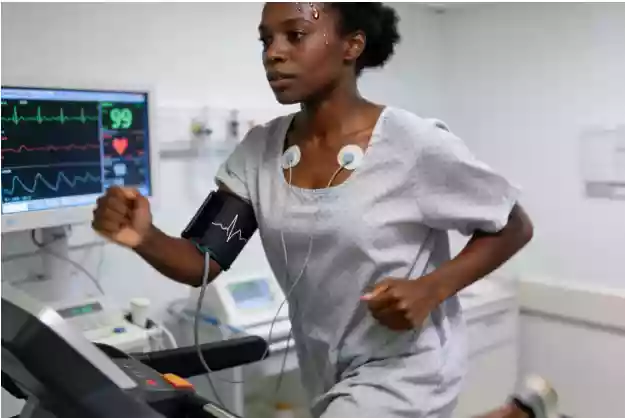
When you arrive at our cardiology department, our team will gently clean a few spots on your chest and attach sticky electrode patches.
These patches are connected by wires to our advanced ECG computers.
We will also wrap a standard blood pressure cuff around your arm.
First, we take your baseline. We look at your heart rate and blood pressure while you are just standing there.
Then, the treadmill starts moving at a very slow, flat, and comfortable walking pace.
Every three minutes, the machine will automatically get a little bit faster, and the incline will tilt upward, simulating walking up a gentle hill.
What is the Doctor Looking For?
As you walk, your leg muscles demand more oxygen. To deliver that oxygen, your heart has to beat faster and pump much harder.
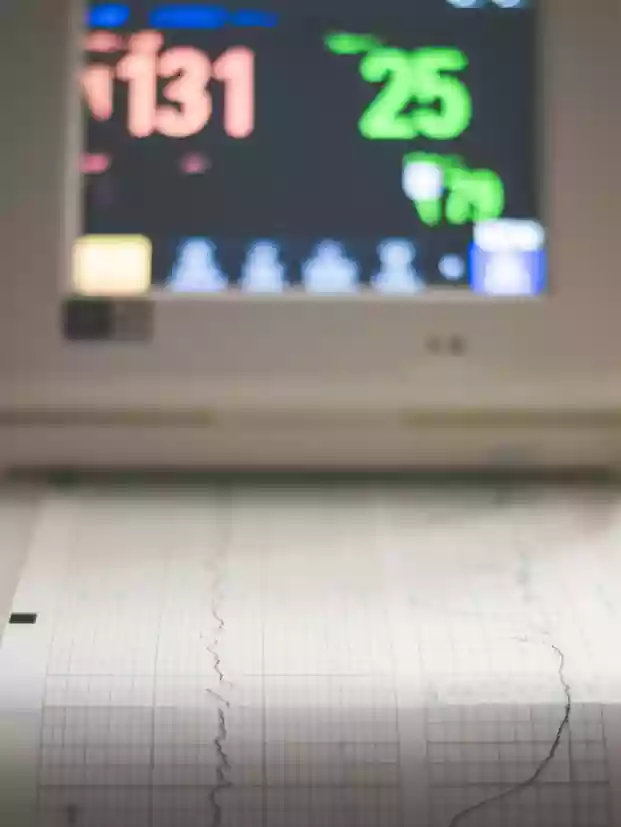
Our cardiology specialists are standing right next to you, watching a computer screen that displays your heart’s electrical signals in real-time.
If your coronary arteries have hidden blockages, the heart muscle will suddenly start starving for oxygen as the exercise gets harder.
When the heart muscle starves for oxygen, it immediately changes its electrical pattern.
The wavy lines on the computer screen will suddenly shift.
You might not even feel chest pain yet, but the computer will see the heart struggling.
That exact moment of struggle is what the doctor is looking for.
It is the warning sign that could literally save your life.
The Warning Signs: Who Needs to Book This Test Today?
Not everyone needs to jump on a treadmill tomorrow.
However, if you fall into any of the categories below, you should not delay in scheduling a comprehensive heart checkup at our clinic.
- You Feel Unexplained Chest Tightness: If you feel a squeezing, burning, or heavy sensation in your chest when you carry groceries, walk up a hill, or do household chores, and that feeling goes away when you sit down to rest, you need this test. This is a classic sign of restricted blood flow.
- You Have a Family History of Sudden Heart Issues: Genetics play a massive role in cardiovascular disease. If your father, mother, or siblings suffered from a heart attack, stroke, or required bypass surgery at an early age, you are at a significantly higher risk. You must be proactive.
- You Get Unusually Winded: If activities that used to be easy for you suddenly leave you completely out of breath, dizzy, or lightheaded, it means your heart is struggling to keep up with basic demands.
- You Live with Chronic Risk Factors: If you have been diagnosed with Type 2 Diabetes, high cholesterol, or hypertension, your blood vessels are already under constant attack. A routine cardiac stress test is a practical tool to ensure your heart isn’t suffering from silent damage.
- You Are Planning to Start a Heavy Exercise Program: If you are over 40 and you are planning to join a gym, start running, or take up intense sports after years of being inactive, it is highly recommended to get cleared by a doctor first to ensure your heart can handle the sudden shock of intense exercise.
Preparing for Your Appointment: The Golden Rules
Getting accurate results requires a little bit of teamwork from you. When you book your appointment at our hospital, our nurses will give you specific instructions, but here is what you absolutely must know beforehand:
- You Must Fast: Do not eat a heavy meal for at least three to four hours before your test. When your stomach is full, your body redirects massive amounts of blood to your digestive system. We need all your blood focused on your heart and muscles for the test to be accurate.
- Absolutely No Caffeine: This is the rule people break the most. You cannot have coffee, strong tea, energy drinks, or even sodas with caffeine for a full 24 hours before your visit. Caffeine artificially stimulates your heart. If your heart is racing from coffee before you even step on the treadmill, the data is completely ruined.
- Dress the Part: Bring comfortable, loose-fitting clothes and a proper pair of walking shoes or sneakers. You are going to be exercising, and you need to be safe and comfortable.
- Talk About Your Pills: Bring a list of every medication you take. Certain drugs, specifically beta-blockers used for high blood pressure, intentionally slow your heart rate down. Our cardiologists might ask you to skip a dose the morning of the test so we can see how your heart acts naturally.
Is It Safe to Push My Heart Like This?
It is incredibly common for patients to feel anxious before they step on the treadmill.
A lot of people ask, “If my heart is weak, isn’t it dangerous to force it to work hard?”
The reality is that a TMT stress test procedure in a professional hospital setting is overwhelmingly safe.
Yes, we are intentionally stressing your body. But you are in the safest possible environment to do it.
You are never left alone. A highly trained medical professional is watching your vital signs every single second.
If your blood pressure spikes too high, if the computer detects a dangerous rhythm, or if you simply say, “I am too tired, I need to stop,” the test is halted immediately.
We do not push you past the point of safety. Our clinic is fully equipped with emergency protocols, oxygen, and medications, ensuring that we can handle any situation instantly.
Finding out your heart has limits while you are surrounded by doctors is infinitely better than finding out your heart has limits while you are alone driving a car or carrying a heavy box in your home.
Understanding Your Results: The Good and The Bad
The best part about an exercise ECG is that the results are immediate. You don’t have to wait two weeks in agonizing suspense.
When the treadmill slows down and you catch your breath, the doctor has the data right there in their hands.
If your results come back “Negative” (which means normal), you can take a massive sigh of relief.
It means that even when pushed to its physical limit, your heart muscle received plenty of blood and your electrical system stayed perfectly stable.
But what if the doctor sits down and tells you the test was “Positive” or abnormal? Take a deep breath.
A positive result can feel terrifying, but it is not a death sentence. In fact, it is a tremendous victory.
An abnormal result simply means we caught the thief before it broke into the house.
We found the hidden blockage before it had the chance to cause a fatal heart attack.
From here, our cardiologists will guide you through the next steps.
We might schedule you for a moving ultrasound of your heart (an Echocardiogram) or recommend specific medications to open your blood vessels and reduce the strain.
You now have a map of the problem, and more importantly, a plan to fix it.